
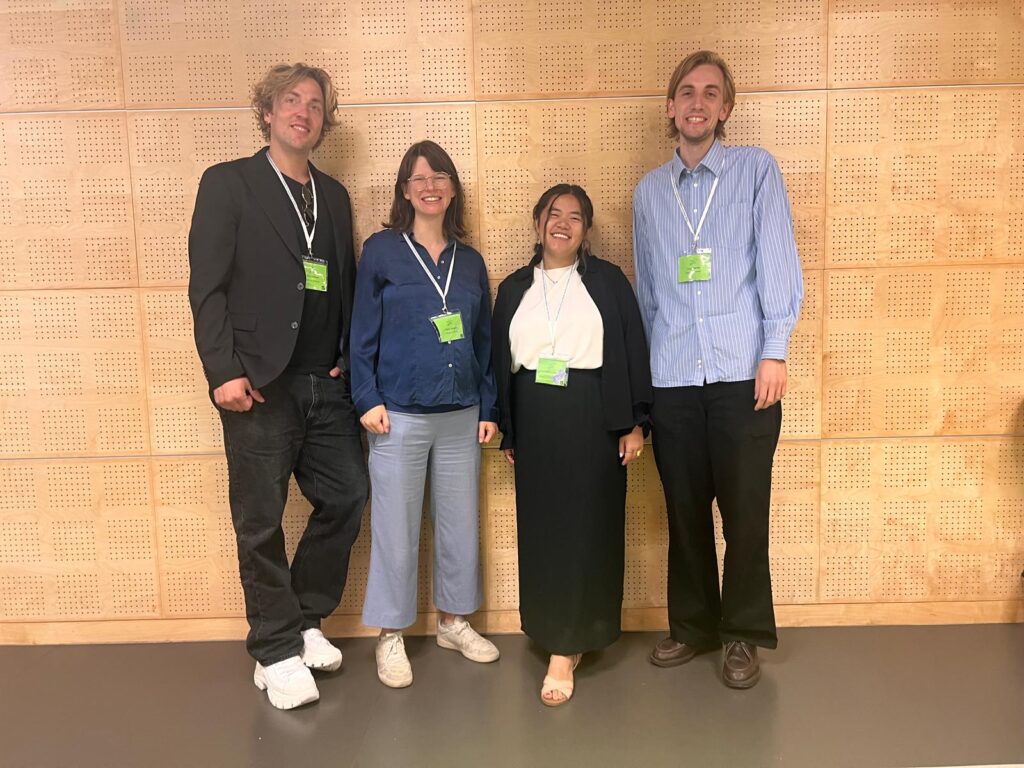
The FutureSpace team was in Kraków in the first week of September for EASST 2026! This year’s theme “More than now: exploring resilient futures” was particularly interesting to us, as the future and future-making practices lie at the core of the project’s interests.
Alongside meeting many STS colleagues and friends (again), attending the engaging plenary sessions, and enjoying various Polish delicacies, we also organized and presented in several panels throughout the conference. Together with Anna Szołucha (Jagiellonian University) and Matjaz Vidmar (University of Edinburgh), Nina convened the panel “Future, materialities and techno-politics of outer space”, featuring 4 interesting and well-attended sessions exploring the entanglements between Earthly power, struggles and infrastructures, and the creation of possible outer space futures.
Within this panel, Helene Sorgner, Philipp Kürten, Pepijn Deroo, and Hannah Schmalstich presented our ongoing conceptual work in a team presentation, entitled “Contour Lines: Towards a Topography of Earth-Space Relations”. Additionally, in the presentation, “Where are the missing markets? (Dis)entangling competition and sovereignty in the European Launcher Challenge”, Hannah presented a paper that she and Helene are writing on the emergence of a new launcher market through the European Launcher Challenge. Pepijn also presented a chapter that he and Nina are writing on interdisciplinary collaboration in ESA’s Concurrent Design Facility, entitled “Engineering Coherence, Orchestrating Multiplicity: An Ethnography of Embodied Expertise and Team Dynamics in Space Mission Design”. We want to thank everyone who attended these sessions for the helpful feedback and for making these sessions fruitful and engaging!
In the panel “Planetary stewardship beyond the escape velocity: Lunar and deep space perspectives on earth-space sustainability” (convened by Lukáš Likavčan, Xiao-Shan Yap, and Jeroen Oomen), Philipp presented a new paper on the temporalities of large and small space organizations in Europe, entitled “Where is time, and when is space? Institutional gravity and the relativity of social time in European outer space governance”.
Overall, we look back very fondly on this busy and interesting week, and we are grateful for all the engaging conversations we had throughout the conference. “Resilient futures” took on many forms throughout the week, and we were glad to learn from and contribute to the diversity of STS scholarship that was brought together under this theme. We cannot wait for the next edition of EASST!